Comet C/2023 A3 Tsuchinshan-ATLAS
Also Known as: Comet Tsuchinshan-ATLAS, Comet Purple Mountain-ATLAS
Object Type: Non-Periodic Hyperbolic comet
Comet Background: A comet is an icy, small Solar System body that warms and begins to release gases when passing close to the Sun, a process called outgassing.
This produces an extended, gravitationally unbound atmosphere or coma surrounding the nucleus, and sometimes a tail of gas and dust gas blown out from the coma.
These phenomena are due to the effects of solar radiation and the outstreaming solar wind plasma acting upon the nucleus of the comet.
Comet nuclei range from a few hundred meters to tens of kilometers across and are composed of loose collections of ice, dust, and small rocky particles.
The coma may be up to 15 times Earth's diameter, while the tail may stretch beyond one astronomical unit.
If sufficiently close and bright, a comet may be seen from Earth without the aid of a telescope and can subtend an arc of up to 30° (60 Moons) across the sky. Comets have been observed and recorded since ancient times by many cultures and religions.
Comets usually have highly eccentric elliptical orbits, and they have a wide range of orbital periods, ranging from several years to potentially several millions of years.
Short-period comets originate in the Kuiper belt or its associated scattered disc, which lie beyond the orbit of Neptune.
Long-period comets are thought to originate in the Oort cloud, a spherical cloud of icy bodies extending from outside the Kuiper belt to halfway to the nearest star.
Long-period comets are set in motion towards the Sun by gravitational perturbations from passing stars and the galactic tide.
Hyperbolic comets may pass once through the inner Solar System before being flung to interstellar space.
The appearance of a comet is called an apparition.
Discovered by: Comet C/2023 A3 (Tsuchinshan-ATLAS) was discovered by the Asteroid Terrestrial-impact Last Alert System (ATLAS)
on 22 February 2023 and it was also independently observed few weeks before in January 2023 at the Tsuchinshan Chinese Observatory (Purple Mountain Observatory of the Chinese Academy of Sciences).
The official designation includes both Tsuchinshan and ATLAS due to these independent observations.
Its retrograde orbit, meaning it moves in the opposite direction to most major solar system objects, is parabolic-like with a perihelion distance of 0.39 astronomical units (AU).
Comet C/2023 A3 (Tsuchinshan-ATLAS) is notable and actively observed because, based on current estimations, it is bright enough to be visible to the naked eye during its perihelion passage between September and October 2024.
Description: C/2023 A3 (Tsuchinshan–ATLAS) (or Comet Tsuchinshan–ATLAS or simply Comet A3) is a comet from the Oort cloud.
The comet passed perihelion at a distance of 0.39 AU (58 million km; 36 million mi) on 27 September 2024,
when it became visible to the naked eye.
Tsuchinshan-Atlas peaked its brightest magnitude shortly after passing the Sun at 9 October, with a magnitude of −4.9 per reported observations at the Comet Observation Database (COBS).
The orbital period of Comet Tsuchinshan-ATLAS was calculated to be more than 80,000 years, however, as it travel through the Solar System, gravitational interactions with other objects can alter the orbit.
The most current calculations from NASA's Solar System Dynamics (SSD) group show that it is on a hyperbolic path, meaning that it will not return. Either way, it is a once-in-a-lifetime event.
Comets get the designation long-period if their orbits are more than 200 years long; C/2023 A3’s orbit is at least 80,000 years long. It most likely came from a region called the Oort Cloud, which is a spherical volume surrounding the planets that may have formed early on in our solar system’s history when icy objects were flung outward away from the Sun due to the gravitational action of the planets. The Oort Cloud has only been theoretically predicted—we’ve never seen Oort Cloud objects out at their vast distances due to their tiny sizes, cold temperatures, and dark color.
The length of its orbital period, how fast it is traveling, and the angle of its orbit all point to C/2023 A3 being an Oort Cloud comet.
At some point in the more recent past, something gravitationally jostled C/2023 A3 (such as the gravitational tug of a passing star) causing it to exit the Oort Cloud, and it started to make its way toward the inner region of our solar system!
Comet C/2023 A3 Tsuchinshan-ATLAS

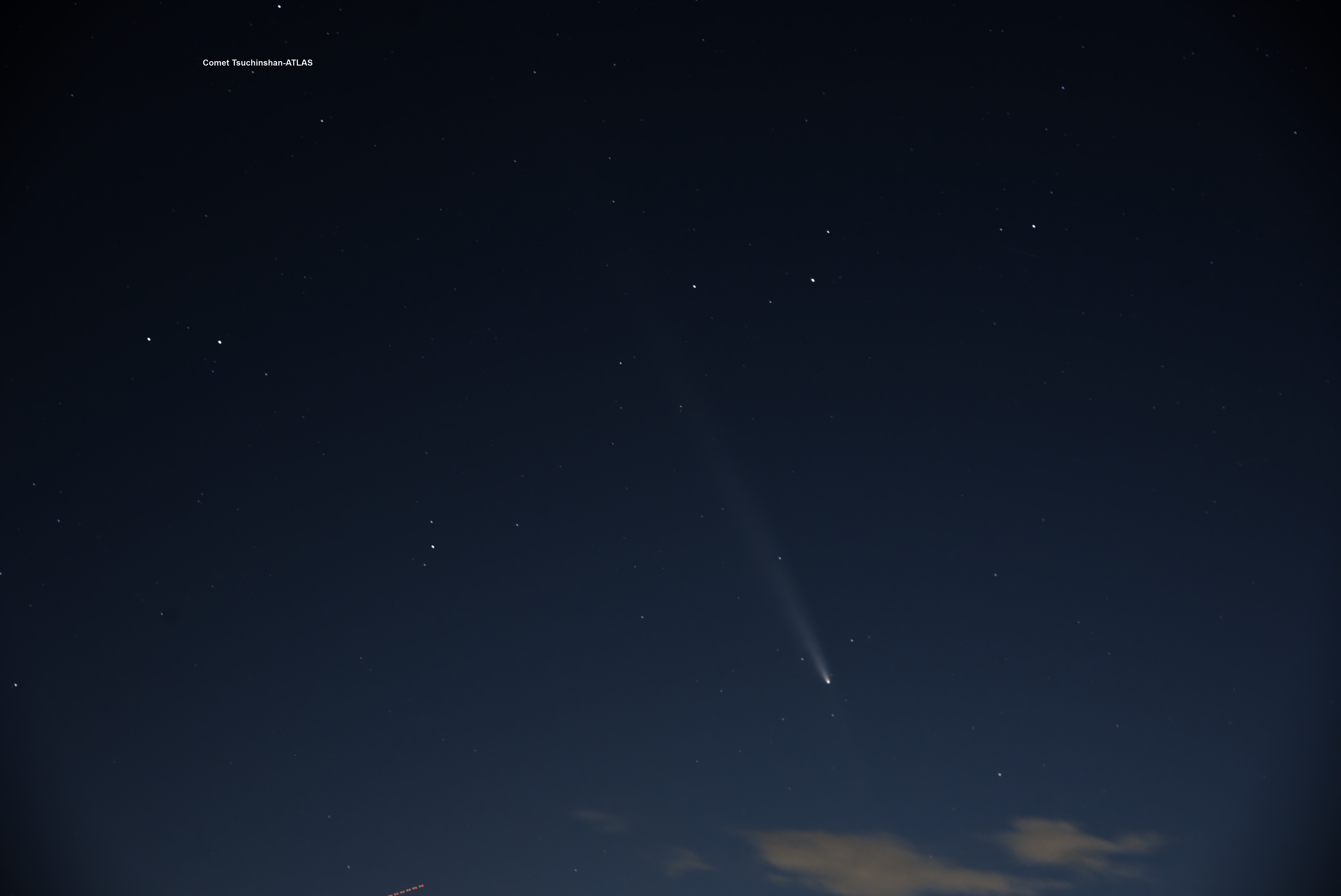
Imaging Details
Click to Return to Home Page